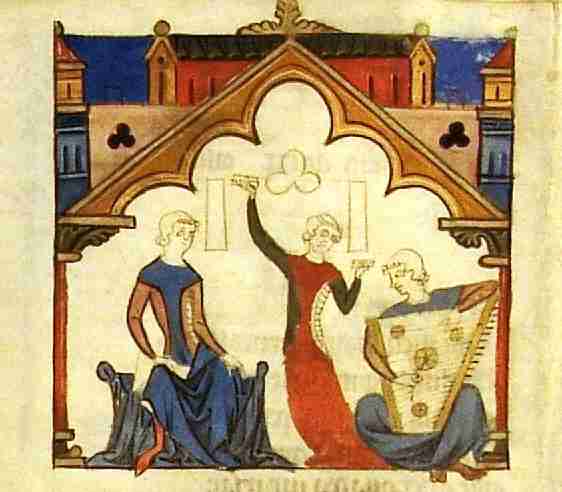
P-EVp (Évora) Biblioteca Pública Pasta 3, doc. 028
P-EVp Pasta 3, doc. 028
Aquitanian notation of Portuguese variety. Lozenges consistently used for semitone indication and for descending chains of notes.
Capitals in tall but rather simple stylized letters in red and blue ink.
At the bottom of Av, modern ink: «Évora, nº 70 (Notarial)»
At the bottom of f. Br, 'Ramalho'.
Very poor. Major tears and holes accounting for about a 20% loss of fol. B contents. One longitudinal hole running through the top of fol. A, with loss of about one line of music. Exposed sides (ff. Av - Br): ink almost completely faded out, ranging from barely readable to unreadable. Non-exposed sides ink in fairly good state.
Seven lines of text and music. Overall dimensions of bifolium: 370 x 554 mm; 370 x 277 mm per folio; text box 260 x 210.
This was probably the outer bifolio of a quire. Several bifolios must have been in place between ff. Av and Br, as the last feast of the former and the first of the latter have a calendric gap of about a month and a half (June 26th, martyrs Joannis et Pauli — August 10th, Laurentii).
The presence of a mass for Taurinus, bishop of Evreux (a city in France some 50 kilometers south of Rouen) is a noteworthy rarity. It is mainly present in sources connected to Normandy, but it was also commemorated at Cluny. As of April 2022 this fragment, in the Cantus Index, was one of only four sources celebrating Taurinus. These sources (from a Cluniac priory in north-eastern France, Rouen, and St. Martial de Limoges after integration into the Cluniac network) report chants generally drawn from the common of confessors. Since the Évora fragment concerns the Mass, comparison is possible just with Rouen (F-Pn lat. 904) and St. Martial (F-Pn lat. 1132), whose liturgical choices differ, except in the Communio. The Évora fragment reproduces exactly the list of chants found in St. Martial, which coincides with those in the printed Cluny Missal of 1493 (fol. 223r). According to the hypothesis advanced by João Pedro d'Alvarenga (https://doi.org/10.57885/rpmns.419), the custom of Évora mirrors the influence of sources sent early on to Évora's cathedral from Coimbra (where a former monk from St. Martial., D. Mauritius, was a bishop between 1099 and 1109 and helped to enforce the Roman rite there). This allows us to posit for this fragment a probable origin in Évora's cathedral, even if its printed Missal (1519) does not keep the corresponding commemoration.
Feast codes Joannis et Pauli, Taurini added at the time of revision.